Is it a Cold or the Flu?

I hear this question every year at the beginning of the flu season. So HOW DO YOU KNOW? How do you know whether it’s a cold or the flu?
Well, there are some real differences.
Fever is rare with a cold. Fever is common with the flu. It’s usually high and lasts 3 to 4 days.
Headaches are rare with cold but common with flu.
Cold sufferers may have slight aches and pains. Flu sufferers have definite aches and pains which may be severe.
Extreme fatigue and/or weakness is just not a factor with a cold. With the flu, exhaustion is common…especially at the onset of the illness.
Sore throat, stuffy nose, and sneezing are common with colds. However, with flu, these symptoms are not important.
Chest discomfort and coughs are mild with colds. A person suffering with a cold may have mild symptoms to include a hacking cough. With the flu, these symptoms can become severe.
With colds, treatment includes antihistamines, decongestants. With the flu, the patient needs to consult with a physician.
Regular Reflexology for the Spirit sessions, Reiki therapy, and chakra healing strengthen the immune system, an important tool in fighting both colds and flu.
Prevention is important. Wash your hands often and stay away from anyone with a cold. These measures also work with flu but include an annual flu shot.
Complications to a cold include sinus congestion, ear infection, and asthma. Complications to the flu can be serious. They include bronchitis and pneumonia.
Thanks for reading this blog/book.
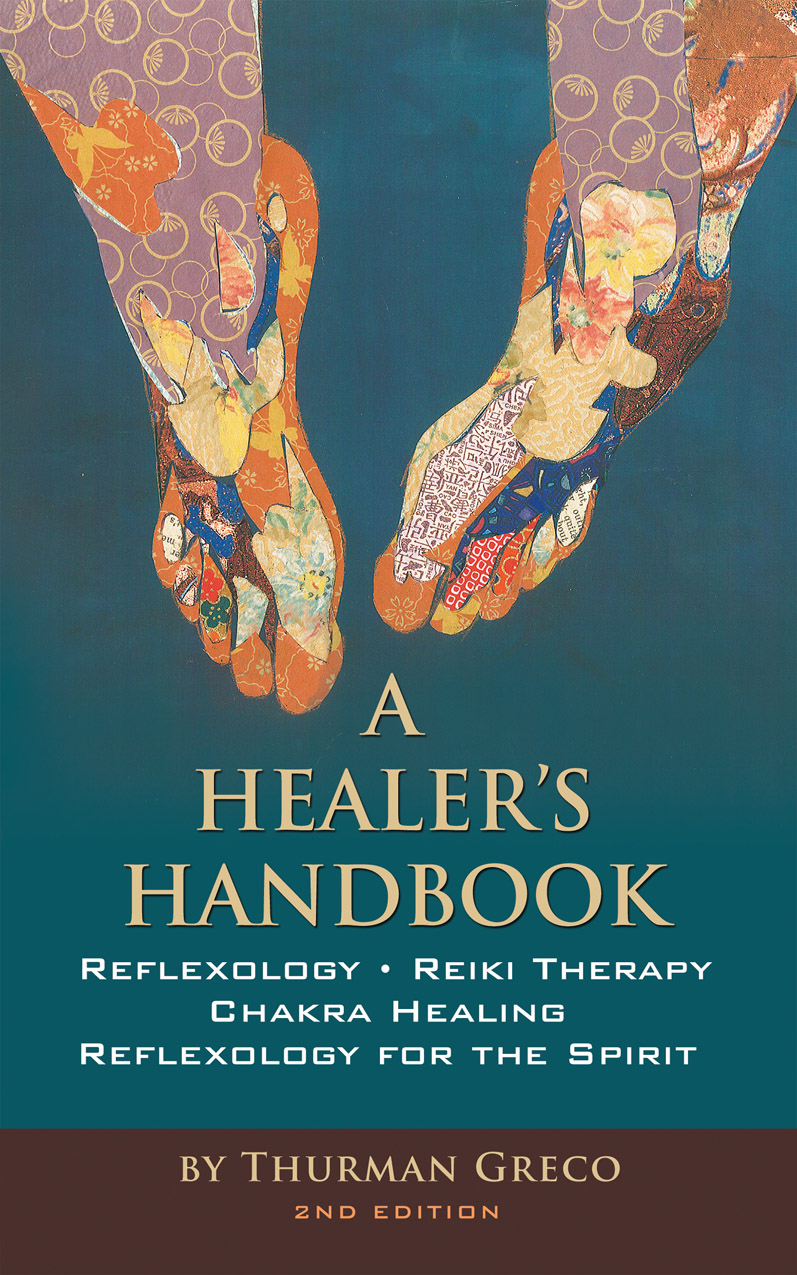
If you are interested in purchasing my new book “A Healer’s Handbook” It is out on Amazon now. After you read it, let me know how it works for you.
Please share this post with your favorite social media outlet.
Thurman Greco
Progress of the Book

The book is, at last, being edited! Real book progress is being made. I hope to get it to the publisher soon. I plan to go over it one last time about mid July.
Thanks to everyone for your patience.
Please share this exciting news (for me, anyway) with your favorite media network.
Thurman Greco
Woodstock, NY
Time-Out for Sharing then Moving on to the Chakras.
 For the past few weeks, I’ve been sharing with you. I’ve offered information in each post for you, in turn, to share with your client partners. I’m following the advice of my teacher and mentor Marge D’Urso who emphasized the many things we can all do in conjunction with reflexology to encourage homeostasis.
Not all of this information applies to all of your client partners.
Some people come to our tables in order to feel better. Others want us to help them take greater charge of their own health. Yet others simply want to hop on the table, receive their reflexology session, and go away blissed out. And, there’s nothing wrong with that.
One special group wants to add other things to their lives which will help them
feel better
look better
avoid chronic disease
live longer
enjoy better health.
By sharing this information slowly, in small increments, you can, along with your reflexology sessions, give your client partners an opportunity to completely change their lives for the better in a non threatening way.
These gradual changes when mixed with reflexology offer dramatic improvements over time. The idea is to be sharing opportunities for good health without complicating lifestyles any more than they already are. You’ll be leading your client partners to a a more healthy lifestyle. They can completely change their lives 1 step at a time.
Slowly
Easily
Comfortably
Not all client partners will adopt every suggestion offered. Some won’t choose any suggestions. Some will try everything suggested for a time. Then, they’ll drop the health step after a few weeks. There’s something here for everyone. We are all different. Our attitudes, ages, and lifestyles are all different.
What’s important is that you are gently, without pushing, sharing suggestions for a healthier lifestyle.
When your client partners are ready, they’ll have this knowledge to use in the way which works best for them.
I’m taking a break with this series of posts to offer you, the reflexologist, some more hands-on posts. Then, I’ll return to these wellness posts for awhile longer…until I feel you have something to offer most client partners over a period of a year or more. You want to be sharing something which a person may accept and live with for awhile before taking on another health giving change. It’s important to let an adopted change settle in so they become lifetime habits.
Beginning next week, I’ll offer posts about Chakras and the feet. We have reflex points for Chakras in our feet. I hope you find these articles interesting. I hope you can use this information in your work!
Thanks for reading this blog/book.
Please refer this post to your preferred social media network.
Don’t forget to join the email list.
Thurman Greco
Buyer Beware – 6 Things to Know About Eating Better

In another time I lived in the interior of Venezuela – 50 miles from headhunters in 1 direction and 50 miles from a grocery store in another direction.
Milk for my family was delivered weekly by a Spaniard who owned an area dairy. I got to know him and his cows very well. It wasn’t that I considered him to be so interesting or entertaining. I was afraid of getting milk infected with tuberculosis. I had 2 toddlers and I was doing everything I could to keep them healthy.
Most of us, when asked, will admit to eating a nearly perfect diet. Delve deeper, and you’ll find that everyone’s diet is different. You’ll also find many of the diets are not healthy…some are not even safe.
It’s hard to know which is the correct diet. There are thousands out there. Many are touted as being the best. We can go into a large book store or library and find an extremely generous selection of cookbooks, each promoting a different way of eating. Top off that with the TV Food channels and the internet and everything becomes confusing.
So, what do you do as a reflexologist when your client partner begins to discuss diet or ask questions about digestion issues?
I offer a few sane suggestions for your own diet as well as that of your client partners, friends, neighbors, and anyone else trying to eat better:
Eat whole foods that are fresh and locally grown. I realize that you may have heard/read this before but I offer new twists on the same old sentence.
Eating locally grown food is important. It’s important to not only know that the food is locally grown, but it’s important to know which farm the food came from.
Can you afford a CSA? If your household is too small, split a membership.
Eating locally grown or raised foods includes
fresh vegetables
fresh fruits
whole grains
beans
fish
lean red meat
dairy products.
When you eat whole, fresh, locally grown foods, you’ll be eating food which experiences less processing, packaging, and shipping.
Foods grown in your area can be picked later, and eaten sooner. Overall, this means a better product.
When I think of fresh foods, I think of health promotion. It’s much better to eat an apple from nearby than to eat pears, apples, strawberries or whatever from South America or China.
And, if you know the farm this food comes from, you’re even better off because you’ll know about the pesticides used. You’ll never be able to learn what pesticides were used on food that came from Chile or China, or any other foreign location, no matter what the label tells you. Our government sends few to no inspectors to faraway places to verify what they say they do.
When you eat whole, fresh, locally grown foods, you’ll be eating better quality food offering the opportunity to protect your heart, stabilize your blood sugar, boost your brainpower, and generally improve your health.
Farmers shipping their products long distances focus on growing foods that travel well as opposed to products that taste better.
Begin your quest for locally grown food at a farmers market.
Don’t be shy. Ask your grocery store produce manager where the food comes from. It goes without saying that we need pure foods if we can get them. Organic, non-GMO, etc., are important.
At the very least, buy organic when you can. Here again, it helps to know which farm the food comes from. The term “organic” doesn’t mean what it did in times past. Many farmers claim to sell organic foods today that could not make that claim in the past. This is because the government has relaxed the organic designation guidelines.
If you’re on a budget, it’s important for some foods to be organic. Foods needing to be organic include:
apples
bell peppers
celery
chard
cherries
domestic blueberries
imported grapes
kale
lettuce
nectarines
peaches
potatoes
spinach
strawberries
Foods that do not necessarily need to be eaten in the organic state include:
asparagus
avocados
cabbage
cantaloupe
eggplant
grapefruit
kiwi
mango
onions
pineapple
sweet corn
sweet onions
sweet peas
sweet potatoes
watermelon
We eat many foods over time. I’ve only listed a very few items. However, the 2 lists offer insight into what constitutes a food needing to be organic and a food that may not.
Staying away from boxed and canned foods is important. They are often filled with additives which are not good for the human body. Many boxed and canned items aren’t even foods. They’re products which have been manufactured to eat. In the 21st century, just because something is sold in a food store to eat doesn’t mean it’s a food.
Food shopping in today’s world not only involves selecting items which are foods – whole, fresh, and local – but also being careful where you buy these items. Just because a store claims to be health oriented doesn’t mean that everything it sells is nutritious or even safe.
Approach each item with a questioning attitude. Read the label. If there are a lot of words which are hard to pronounce, return the item to the shelf.
Your grocer is in business to make $$$. Food is put on the shelves to sell. Just because it’s on the shelves doesn’t guarantee that it’s healthy or even safe.
This doesn’t mean that eating can’t be fun. It can be. It’ll be even more fun once you know exactly what you’re eating.
If you can, buy your breads from a local bakery which uses organic whole grains.
Become knowledgeable about your dairy, meat, and fish products. If at all possible, stay away from fish that are farmed.
If you eat meat, eggs, cheese, try to get products coming from animals that are free range, organic fed.
Purchase eggs coming from cage free hens.
Ham, bacon, and smoked fish should have no synthetic nitrates or nitrites.
Meats should be hormone free, free range grazed, and antibiotic free.
I realize that not everyone has access to these foods. We can’t eat what we don’t have access to. I also realize that these foods may be expensive. We also can’t eat what we can’t buy. Everyone faces choices when it comes to food shopping. Staying away from processed foods can free up some funds for fresh, whole, local.
It’s okay to be a food snob only wanting the most nutritious, healthiest food available.
Thanks for reading this blogged book.
Please refer this post to your preferred social media network.
I hope you found this article helpful. Please leave your comments below and check out the other posts.
Don’t forget to join the email list.
Other blogs you may enjoy:
Peace and food for all
Thurman Greco